
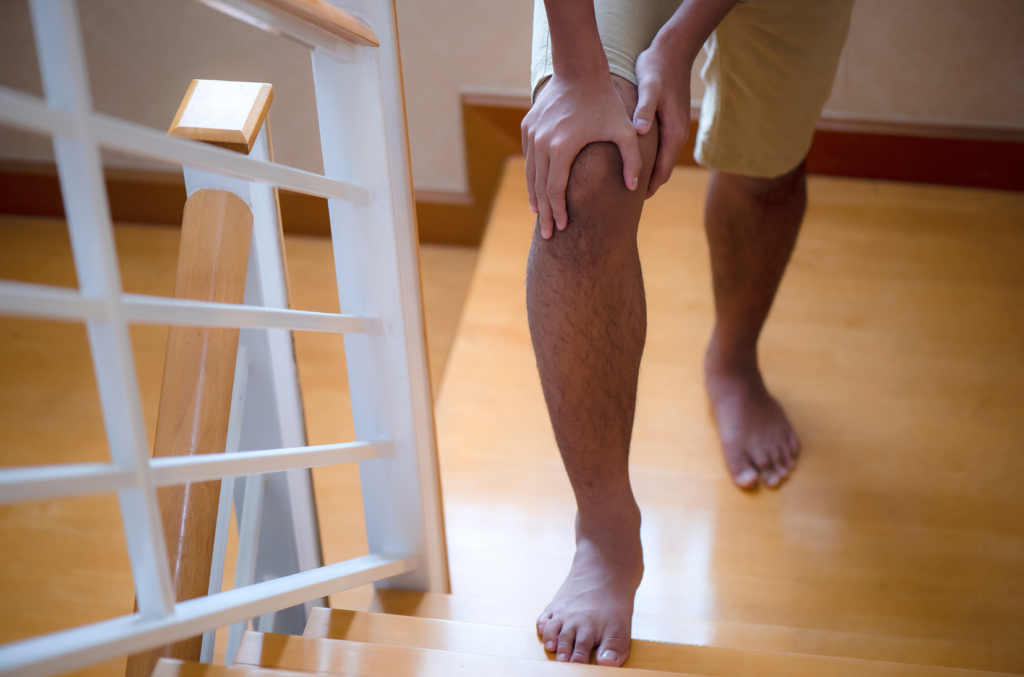
For many people, the first sign of knee trouble shows up on stairs. The climb to a second-floor office, the steps down into a favorite restaurant or the staircase they’ve used a thousand times at home suddenly cause hesitation. Someone may take steps more slowly, rely more on the railing or find reasons to limit stair use.
It’s easy to write off stair-related knee discomfort as a normal sign of aging or try to push through and hope the problem fades. But knee pain on stairs may be your body’s way of signaling a problem that can be treated.
That’s where Dr. Sarah Scharf comes in. A chiropractor with two decades of clinical experience, she founded Marin Joint Health in Marin County to help active adults get to the bottom of knee pain. Her approach starts with asking what knee pain is signaling and helping patients understand non-surgical options, more involved interventions, or a combination of both.
1. Pain Under the Kneecaps When Going Up Stairs
Some people describe it as a pressure behind the kneecap. You typically don’t feel it as a tender area like a bruise.
What It Might Feel Like
You might feel a dull ache or sharp twinge right under the kneecap as you push up to the next step. This type of discomfort tends to show up most when you load the leg to lift your body weight. It might also linger, causing pain after you sit for a while and then stand back up.
What the Issue Might Signal
The kneecap is supposed to glide smoothly in a groove at the end of the thigh bone. When it’s pulled slightly off, it can press unevenly against the surfaces behind it, causing friction and pain.
Dr. Scharf explains that climbing stairs concentrates that pressure because you’re loading a bent knee with your full body weight. This discomfort might point to root causes like:
- Tight muscles in the hip and thigh
- Imbalanced muscle function across the legs or body
- Alignment issues further up or down the leg
2. Pain When Going Down Stairs More Often Than When Going Up
Many people instinctively start leading with the same leg when descending stairs. Or, you might realize you’re gripping the handrail harder than normal to reduce weight on the problematic knee. You might find yourself increasingly trying to control your descent because your knee doesn’t feel reliable.
What It Might Feel Like
Going up stairs may feel manageable, but when you come back down, you might feel a deep ache or a sense that the joint is absorbing more than it should with each step.
What the Issue Might Signal
When you go downstairs, the muscles around the knee lengthen and move slowly to help control the pull of gravity on your body weight. This load puts more demand on areas around the joint, says Dr. Scharf, so pain that’s mostly experienced on the way down can signal muscle dysfunction or irritated cartilage.
3. Pain on the Inside or Deep in the Knee
Dr. Scharf points out that pain can often sit along the inner edge of the knee or feel buried somewhere deep inside the joint.
What It Might Feel Like
When you’re walking on stairs, it can feel like a pinch, catch, or heavy ache, and you might not be able to point to where it originates exactly.
What the Issue Might Signal
Deeper pinching or catching sensations may point to meniscus involvement. The meniscus is the cartilage that cushions the knee bones. Other issues might include joint irritation or reduced space between the bones.
4. Grinding or Clicking on the Stairs
Sometimes, it’s noise with no pain; other times, it comes with a gritty, catching sensation. Dr. Scharf notes that it often becomes more noticeable on stairs because the knee bends under load rather than moving freely.
What It Might Feel Like
You might hear or feel grinding, clicking, or crunching as the knee bends and straightens on the steps. The technical term for this is crepitus.
What the Issue Might Signal
On its own, noise without pain is common, particularly as people age. It’s often nothing to worry about. However, when it comes with a gritty, catching sensation or pain, it can signal that cartilage on the back of the kneecap or inside the joint has roughened, or that the kneecap isn’t tracking cleanly.
You might notice these issues when walking up and down stairs well before they show up with other movements. That’s because the knee bends under the load when you climb stairs, pressing the internal surfaces of the knee together.
5. A Knee that Feels Like It Might Give Out
You might notice yourself slowing down, watching your feet or reaching for the railing for greater support.
What It Might Feel Like
Your knees may not feel trustworthy; you might expect them to buckle mid-step.
What the Issue Might Signal
A knee that feels like it might buckle can be a sign of damage or dysfunction to the surrounding area. Stability when moving requires muscles around the knee to work at the right time and with enough strength. If the nervous system doesn’t signal those muscles correctly or the muscles are weak, your knee can feel unreliable even when the joint itself is sound.
Stairs put these coordinated functions to the test more than general walking because climbing and descending demand well-timed muscle control.
6. Pain in Both Knees Related to Stairs
The pain may not be identical, but the pattern is similar enough that it feels like a shared problem across both legs.
What It Might Feel Like
You might feel discomfort in both knees, but the pain is greater in one.
What the Issue Might Signal
Your knees are connected to a single pelvis and everything above that. They’re also both impacted by the state of your feet and your gait. When both knees hurt when you climb stairs, it may signal a problem that starts somewhere else in the body.
What Do You Do When Your Knees Are Speaking?
Knee pain doesn’t occur in a vacuum. The knees are part of what’s known as the kinetic chain. How the hips, ankles, feet and other parts of the body move impacts muscle function and load on joints. As major joints in the middle of that chain, the knees absorb and react to everything else.
That’s the idea behind Dr. Scharf’s work at Marin Joint Health. Her 12-week program doesn’t treat knee pain as an isolated problem; it looks at the full chain of movement above and below the knee. Her protocol works to correct those mechanics, calm irritated tissue and muscles and help patients rebuild strength and coordination to support a stabler knee.