
As clinical research advances beyond first-generation compounds, scientists are rethinking what psychedelic-inspired therapies could look like and how they may reshape the future of mental healthcare.
For decades, psychedelic compounds occupied the fringes of medical research. Today, they’re at the center of one of the most active areas of neuroscience.
From psilocybin and LSD to entirely new classes of psychedelic-inspired molecules, researchers are exploring novel approaches to treating depression, anxiety, post-traumatic stress disorder (PTSD), addiction, and other neuropsychiatric disorders that continue to challenge conventional therapies.
The conversation, however, has changed dramatically over the past few years.
It’s no longer simply about whether psychedelics work.
Researchers are now asking a far more important question:
Can we preserve their therapeutic benefits while improving safety, accessibility, and scalability?
That question is driving what many scientists consider the next generation of psychedelic medicine.
A Mental Health Crisis Demands New Thinking
Mental health disorders remain among the leading causes of disability worldwide. Despite decades of pharmaceutical innovation, millions of patients continue to cycle through multiple antidepressants and anxiety medications without achieving meaningful symptom relief.
Traditional antidepressants can take weeks to become effective and are often associated with modest response rates. Even among patients who initially respond, relapse remains common.
These limitations have fueled renewed interest in therapies capable of producing rapid and sustained improvements.
Over the past several years, clinical studies involving psilocybin, MDMA, and other psychedelic compounds have demonstrated encouraging results across several difficult-to-treat psychiatric conditions. Unlike many existing medications, these therapies appear capable of producing durable effects after relatively few administrations when combined with psychological support.
Those findings have fundamentally changed how many researchers think about treating mental illness.
From Symptom Management to Neuroplasticity
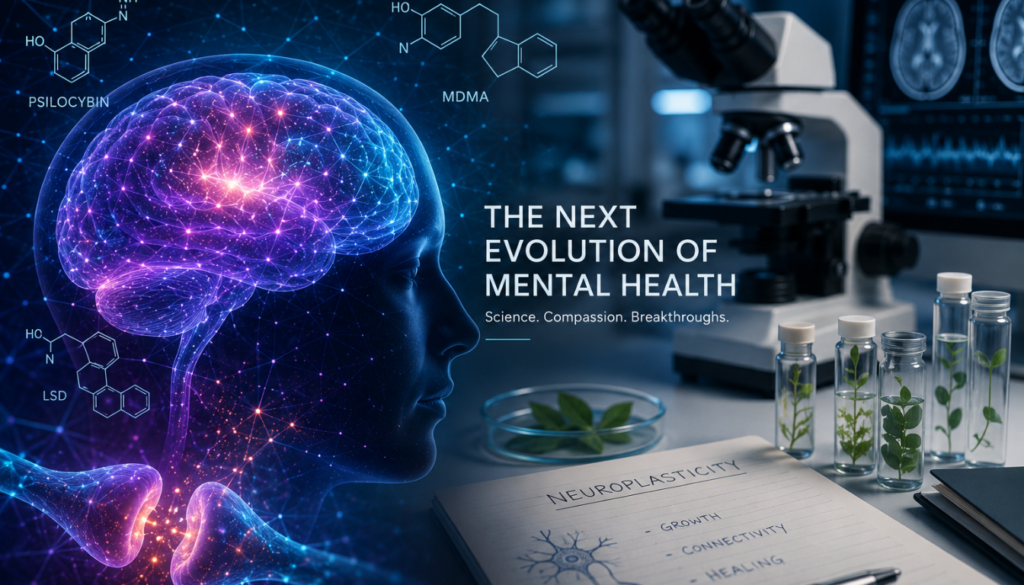
One of the most significant scientific developments has been a growing appreciation for the role of neuroplasticity.
Rather than simply altering neurotransmitter levels, psychedelic compounds appear to promote the brain’s ability to reorganize and strengthen neural connections. Researchers believe this process may help “reset” dysfunctional neural circuits associated with depression, trauma, and anxiety.
While the exact mechanisms remain under investigation, studies suggest that activating serotonin receptors, particularly 5-HT2A, initiates downstream biological changes that support synaptic growth and neural connectivity.
This represents an important shift in thinking.
Instead of managing symptoms alone, scientists are increasingly exploring therapies designed to address the underlying biology of psychiatric disease.
The Field Is Already Moving Beyond Classic Psychedelics
Although first-generation psychedelic therapies continue advancing through clinical development, researchers are already designing entirely new molecules inspired by them.
This emerging field includes compounds engineered to reduce treatment duration, minimize adverse effects, improve selectivity, or eliminate hallucinations altogether.
These therapies are often described as next-generation neuroplastogens.
Unlike traditional psychedelics, neuroplastogens seek to harness the biological mechanisms responsible for promoting neuroplasticity without producing profound alterations in consciousness.
The concept is attracting growing scientific interest because it addresses one of the largest practical challenges facing psychedelic medicine.
Many psychedelic-assisted therapies require extensive patient preparation, several hours of supervised dosing, and structured integration sessions afterward. While appropriate for some patients, this model presents logistical and economic challenges that may limit widespread adoption.
Researchers are increasingly asking whether similar therapeutic outcomes could eventually be achieved through medicines that integrate more seamlessly into existing healthcare systems.
Companies Are Taking Different Scientific Approaches
The diversity of research underway reflects just how rapidly the field is evolving.
Compass Pathways continues to advance COMP360, a synthetic psilocybin formulation currently among the most advanced psychedelic therapies in clinical development for treatment-resistant depression. The company’s research has contributed significantly to understanding dosing strategies, durability of response, and clinical implementation.
MindMed is investigating multiple psychedelic compounds across anxiety disorders, ADHD, and other neuropsychiatric conditions. Its portfolio reflects growing interest in tailoring different molecules to specific psychiatric indications rather than pursuing a one-size-fits-all approach.
Meanwhile, companies such as Enveric Biosciences are pursuing an entirely different strategy. Rather than developing classic psychedelics, Enveric is engineering novel neuroplastogenic compounds designed to preserve therapeutic activity while avoiding hallucinogenic effects. Its lead candidate, EB-003, is being studied for potential applications in depression, anxiety, and PTSD as part of a broader effort to improve scalability and patient accessibility.
Together, these programs illustrate that psychedelic medicine is no longer defined by a single class of compounds.
It has become a diverse field of neuroscience focused on understanding the biological mechanisms that drive recovery.
Policy Is Beginning to Reflect Scientific Progress
Scientific momentum is increasingly being matched by regulatory engagement.
Recent actions by U.S. policymakers, including efforts to accelerate research into treatments for serious mental illness, signal broader recognition that psychiatric innovation deserves greater attention.
Although regulatory approval remains dependent on rigorous clinical evidence, these initiatives may help reduce barriers to research and encourage continued investment in promising therapeutic approaches.
For clinicians, researchers, and patients alike, that represents meaningful progress.
The Future May Look Different Than Many Expected
The public often associates psychedelic medicine with altered states of consciousness.
Ironically, some of the most promising research underway aims to move beyond them.
The future of the field may ultimately be defined not by the psychedelic experience itself, but by a deeper understanding of the molecular pathways that enable the brain to heal.
If researchers can successfully separate neuroplasticity from hallucinations, it could dramatically expand access to these therapies and make them more compatible with mainstream psychiatric care.
Whether through traditional psychedelic-assisted therapy or next-generation neuroplastogens, the destination remains the same: developing faster, more effective treatments for patients whose needs have gone unmet for far too long.
For neuroscience, this is no longer simply a story about psychedelics.
It is increasingly becoming a story about the future of mental health treatment itself.