
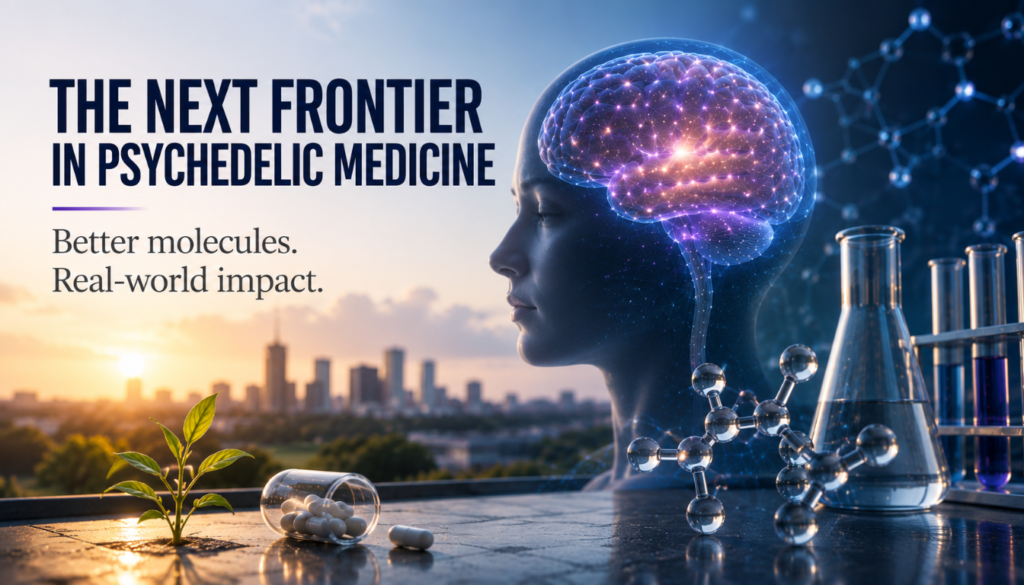
A wave of acquisitions, evolving FDA policy, and advances in neuroplasticity research suggest the future of psychiatric medicine may lie beyond traditional psychedelic therapies.
For years, the psychedelic medicine industry was driven by one overarching goal: prove that these compounds could change the way mental illness is treated.
That goal is rapidly being accomplished.
Clinical studies involving psilocybin, MDMA, LSD and other psychedelic compounds have generated compelling data across treatment-resistant depression, PTSD, anxiety disorders and addiction. What was once dismissed as fringe science has become one of the most active areas of neuroscience research.
Yet something even more interesting is beginning to happen.
The industry’s biggest players are no longer asking whether psychedelic medicines work.
They’re asking how to make them work better.
That subtle shift is beginning to reshape everything from drug discovery and clinical trial design to pharmaceutical investment strategy.
The Validation Has Arrived
The strongest endorsement of psychedelic-inspired medicine hasn’t come from investors or advocacy groups.
It has come from Big Pharma.
Over the past several years, some of the world’s largest pharmaceutical companies have aggressively expanded into the sector through acquisitions worth billions of dollars.
Otsuka Pharmaceutical’s acquisition of Mindset Pharma marked one of the earliest moves into next-generation psychedelic drug discovery. More recently, Otsuka doubled down with its acquisition of Transcend Therapeutics, bringing a novel methylone-based PTSD therapy into its neuroscience portfolio.
AbbVie followed by acquiring Gilgamesh Pharmaceuticals’ lead asset, bretisilocin, in a deal valued at up to $1.2 billion, recognizing the growing commercial potential of psychedelic-inspired neuroscience.
Perhaps the clearest signal came this year when Eli Lilly announced its agreement to acquire AtaiBeckley for up to $3.8 billion, gaining access to one of the industry’s most advanced portfolios of psychedelic therapeutics.
Collectively, these transactions represent far more than individual acquisitions.
They demonstrate that large pharmaceutical companies increasingly view neuroplasticity as one of the most promising frontiers in psychiatric medicine.
The Science Is Evolving Faster Than The Headlines
Public conversations about psychedelic medicine often remain focused on altered states of consciousness.
The science has already moved well beyond that discussion.
Researchers increasingly believe that one of the primary therapeutic mechanisms underlying psychedelic medicines is their ability to promote neuroplasticity, the brain’s capacity to form and reorganize neural connections.
That insight has fundamentally changed drug discovery.
Instead of simply developing new psychedelic compounds, scientists are attempting to identify exactly which receptor pathways drive therapeutic benefit and determine whether those biological mechanisms can be activated without inducing hallucinations.
The result is an emerging class of medicines known as neuroplastogens.
Rather than emphasizing the psychedelic experience itself, these compounds are designed to stimulate neural repair while potentially avoiding many of the logistical and clinical challenges associated with traditional psychedelic-assisted therapy.
The FDA May Have Quietly Reinforced This Shift
The FDA’s recently finalized guidance on psychedelic drug development reflects just how sophisticated the field has become.
Although the guidance primarily addresses classic psychedelic compounds, much of its attention focuses on practical issues that extend beyond efficacy alone.
The agency discusses functional unblinding, patient monitoring, psychotherapy, abuse potential, repeat dosing, and the challenges of conducting rigorous clinical trials involving drugs that produce profound perceptual effects.
Those observations highlight an important reality.
Some of the greatest barriers facing psychedelic medicine are no longer scientific.
They’re operational.
As Joseph Tucker, Ph.D., CEO of Enveric Biosciences, noted following the release of the guidance, “The agency is not lowering the standard. It is giving developers a clearer view of the issues that must be solved, including functional unblinding, patient monitoring, abuse potential, repeat dosing, and the role of psychotherapy.”
For many researchers, the guidance effectively validates the industry’s growing emphasis on developing therapies capable of addressing these challenges from the outset.
Designing Around The Problem
Among companies pursuing that strategy, Enveric Biosciences has adopted perhaps one of the most differentiated scientific approaches.
Rather than modifying existing psychedelic compounds, the company has built its pipeline around purpose-designed neuroplastogens intended to preserve therapeutic biology while avoiding hallucinogenic effects.
Its lead candidate, EB-003, was specifically engineered to selectively engage both 5-HT2A and 5-HT1B receptors, receptor pathways believed to play important roles in promoting neuroplasticity while potentially supporting rapid and durable antidepressant and anxiolytic effects. According to the company, the molecule was intentionally designed to address many of the very issues highlighted throughout the FDA’s finalized guidance.
Those include the possibility of maintaining more effective blinding in clinical studies, reducing prolonged patient monitoring, minimizing psychotherapy-related confounding variables, and ultimately supporting a more scalable outpatient treatment model if the compound’s non-hallucinogenic profile is confirmed clinically.
“Many of the hardest development and commercial problems in this field are not necessarily created by the therapeutic target,” Dr. Tucker said. “They are created by the hallucinogenic experience.”
Whether EB-003 ultimately fulfills that promise remains to be demonstrated in human studies, but its design philosophy illustrates how rapidly the field is evolving.
A New Definition Of Psychedelic Medicine
Ironically, the future of psychedelic medicine may not be psychedelic at all.
The industry’s most exciting advances are increasingly centered on understanding the biology responsible for lasting therapeutic effects rather than reproducing the subjective psychedelic experience itself.
That evolution mirrors broader trends throughout pharmaceutical research.
Drug development rarely stops with first-generation compounds.
Scientists refine mechanisms, improve selectivity, reduce adverse effects, and design molecules that better fit clinical practice.
Psychiatry now appears to be entering that same phase.
Beyond The Renaissance
The psychedelic renaissance helped establish that profound improvements in mental health may be possible through entirely new biological mechanisms.
The next chapter will likely determine how broadly those discoveries can benefit patients.
With regulators providing greater clarity, pharmaceutical companies making multibillion-dollar commitments, and next-generation neuroplastogens moving steadily toward the clinic, the conversation is shifting from possibility to implementation.
The companies that define the next decade may not be those that simply developed psychedelic medicines.
They may be those that learned from them and built something even better.