

A survey of 18,000+ Americans shows depressed patients across all age groups are building their own treatment plans, and the healthcare industry may be the last to notice.
The standard treatment path for depression has not fundamentally changed in decades. A patient sees a doctor, receives a prescription and waits four to six weeks to see if the medication works. For most, it doesn’t. Two-thirds of patients don’t respond to their first antidepressant. The average person cycles through two or three prescriptions before finding one that helps, a process that can stretch across months and cost hundreds of dollars in copays, follow-up visits and lost productivity.
According to a new report from precision psychiatry company NeuroKaire, patients have been responding to this failure for years. They just haven’t been doing it inside the healthcare system.
The Self-Medication Generation, conducted in partnership with research firm Prosper Insights & Analytics, surveyed more than 18,000 U.S. adults and identified a depression cohort of 3,737 respondents. The findings reveal a self-medication pattern that is not limited to any single age group or demographic. It spans every generation, and the scale is striking.
Self-medication is consistent across the age spectrum.
Self-medication might seem like it would be a young person’s behavior, but the data shows otherwise. While Gen Z draws the most attention, the NeuroKaire report shows that depressed Americans of every age are assembling their own treatment approaches outside the clinical system.
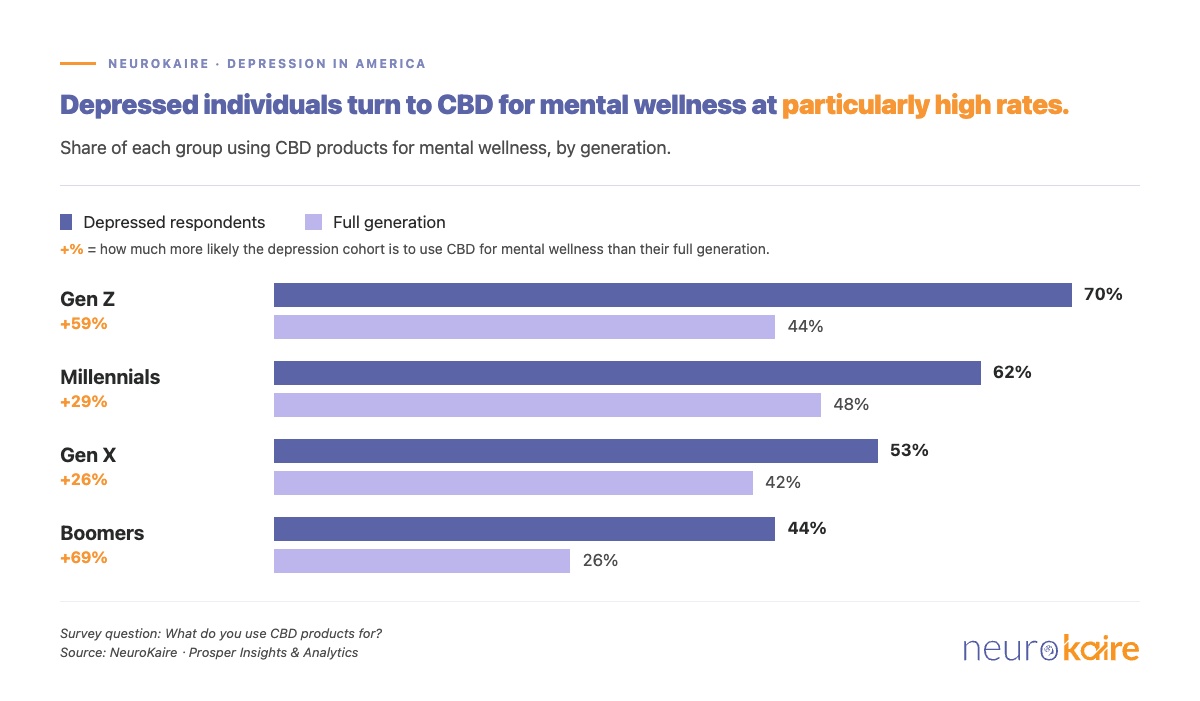
Cannabis use in various formats is the most visible example. Half of Gen Z adults with depression use marijuana, and 70% of Gen Z CBD users with depression say they use it specifically for mental wellness. But they’re not alone. Among depressed Boomers, marijuana use is 74% higher than among their non-depressed peers, the largest relative gap of any generation. Among depressed Boomer CBD users, 44% use it for mental wellness, 71% more than their peers.
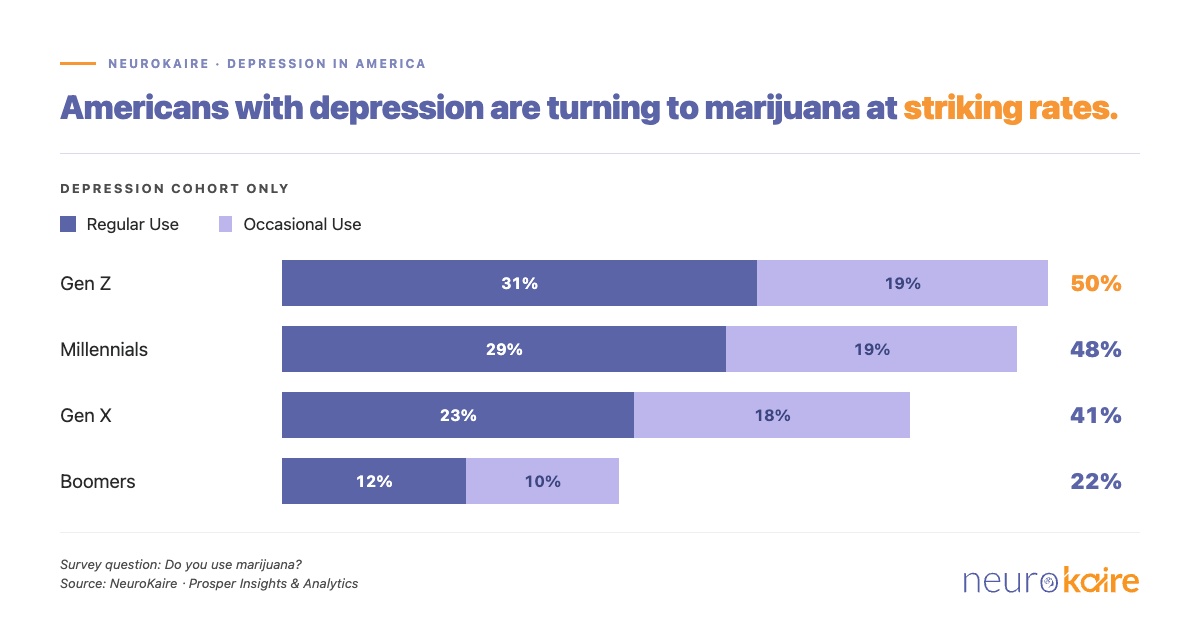
Cannabis-based self-medication is not a generational trend. It is a cross-generational response to a system that is not meeting patient needs.
The same pattern appears with weight-loss medications. Depressed adults are 70% more likely than the general population to be taking prescription weight-loss drugs. The gap is widest among Boomers, where depressed individuals are 2.2 times more likely to be on GLP-1 medications than their peers. Depression alters how patients perceive their bodies, and weight gain is a documented side effect of many commonly prescribed antidepressants. The result is a co-occurring cluster of depression, weight and medication use that cuts across every age group in the study.
How patients make medicine and treatment decisions is shifting.
Perhaps equally significant for the healthcare industry is where depressed Americans are getting their health information. The NeuroKaire report found that depressed adults are not necessarily deferring to their healthcare providers for guidance; they’re looking to everything from social media and user-generated product reviews to word of mouth and communities like Reddit.
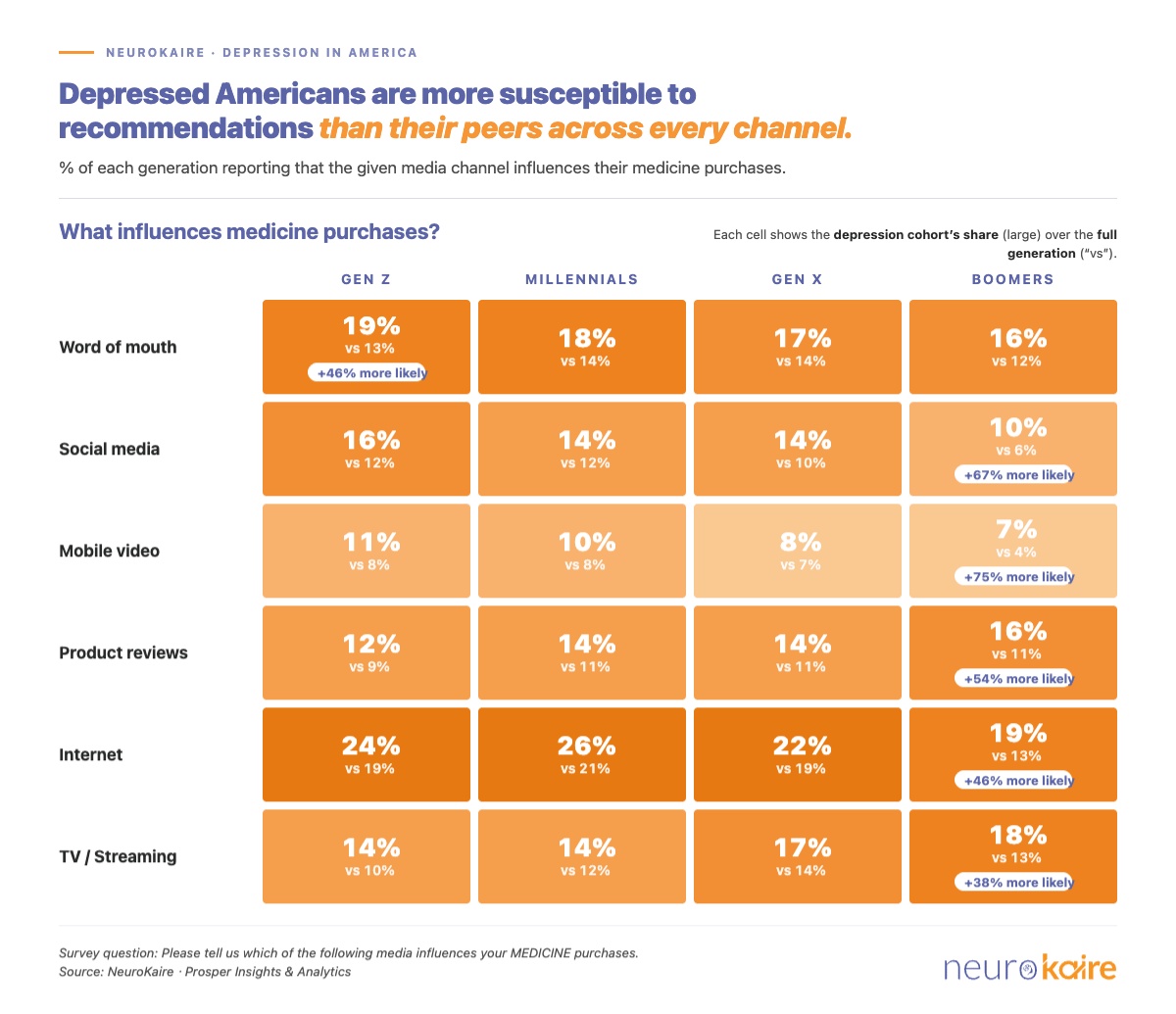
Among depressed Gen Zers, word of mouth influences medicine purchases 52% more than it does for the rest of their generation. Social media’s influence is 37% higher. But as with their use of cannabis, this is not only a young person’s pattern. Depressed Boomers are 57% more likely than their peers to say social media influences their medicine purchases, and 84% more likely to say email advertising does. Across every age group–Gen Z, Millennials, Gen Z and Boomers–depressed Americans are turning to peer networks, digital content and self-directed research to inform decisions that would traditionally be made inside a clinical relationship.
Dr. Daphna Laifenfeld, a Harvard-trained neuroscientist and NeuroKaire’s Chief Science Officer, said the data points to a trust gap. “When patients cycle through multiple failed medications, each chosen arbitrarily through a trial-and-error process, they lose confidence in the process,” she said. “They don’t stop looking for answers. They just start looking somewhere else. What our data shows is the scale at which that is happening, and it is far larger than most clinicians or health systems realize.”
Pharma may be spending in the wrong places.
The data also raises a pointed question for pharmaceutical marketers. Anyone who watches the evening news has noticed that nearly every commercial break features an ad for a depression or weight-loss drug. Television remains the dominant channel for pharma advertising spend. But the NeuroKaire report suggests the audience pharma is trying to reach may already be looking elsewhere.

Even among Boomers, the generation most associated with traditional TV viewing, the data tells a surprising story. Depressed Boomers over-index their peers on social media influence for medicine purchases by 57%, on mobile video by 55% and on product reviews by 49%. Their over-index on TV influence is 40%. In other words, the digital channels that receive a fraction of pharma’s ad budget are showing a bigger influence gap among depressed Boomers than the channel that gets the lion’s share.
The pattern is even more pronounced among younger generations. For depressed Gen Zers, 51% get their news from TikTok. Social media influences their medicine purchases 37% more than it influences the rest of their generation, while TV’s influence gap is 36%. And across every age group, word of mouth consistently outperforms celebrity endorsements as an influence on medicine purchases. Only 8% of depressed Gen Zers look to celebrity influencers for health guidance.
For an industry that spends billions annually on television advertising to reach depressed Americans, the NeuroKaire data suggests the most reachable patients may already be getting their information through channels that pharma has historically underinvested in.
Economic barriers are accelerating the cycle.
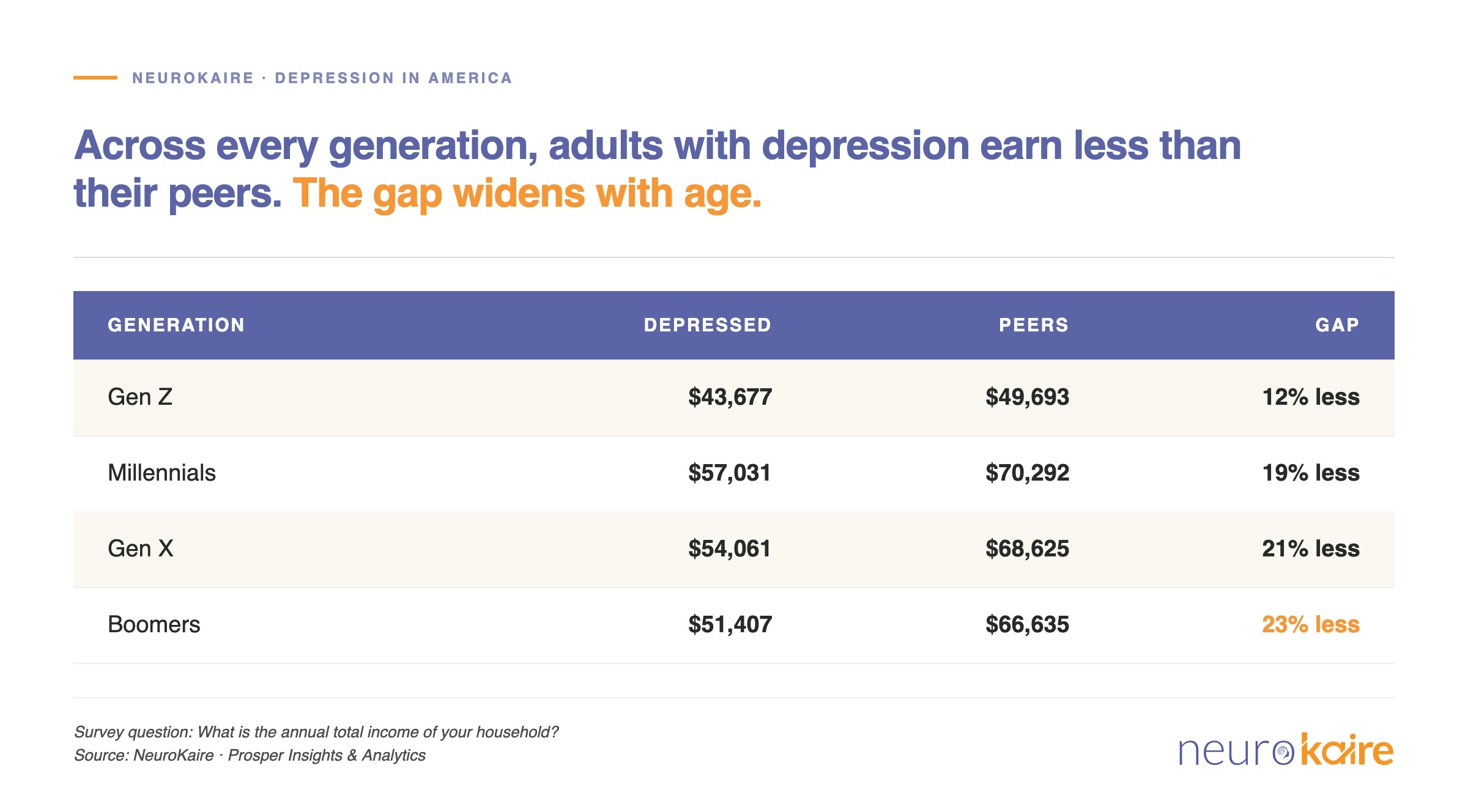
The report also reveals the economic forces driving patients away from traditional treatment. Across every generation in the study, depressed adults report lower household incomes than their peers, from 12% less among Gen Z to 23% less among Boomers.
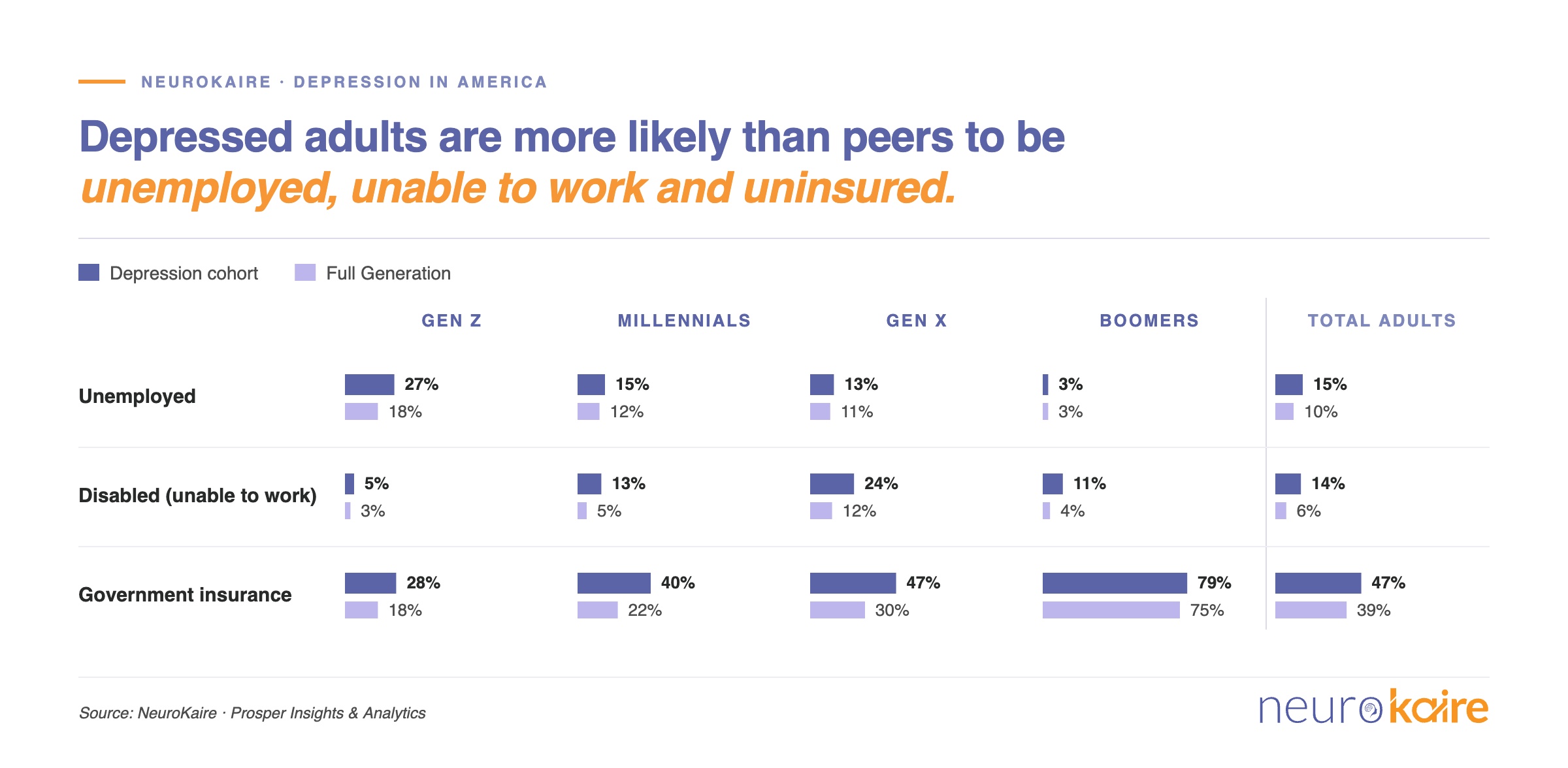
Depressed adults are less likely to have employer-sponsored insurance and more likely to be on government plans. Disability rates among depressed Americans are 133% higher than the general population. Among depressed Boomers, in particular, the disability rate is 175% times higher than their peers.
Every failed prescription in the trial-and-error model carries a direct cost: the medication, the follow-up appointment, the time off work and the continued burden of untreated symptoms. For patients already earning less and insured worse than their peers, the economics of the current model push them toward self-medication not as a preference but as a practical necessity.
If the healthcare system has been waiting for a sign, this may be it.
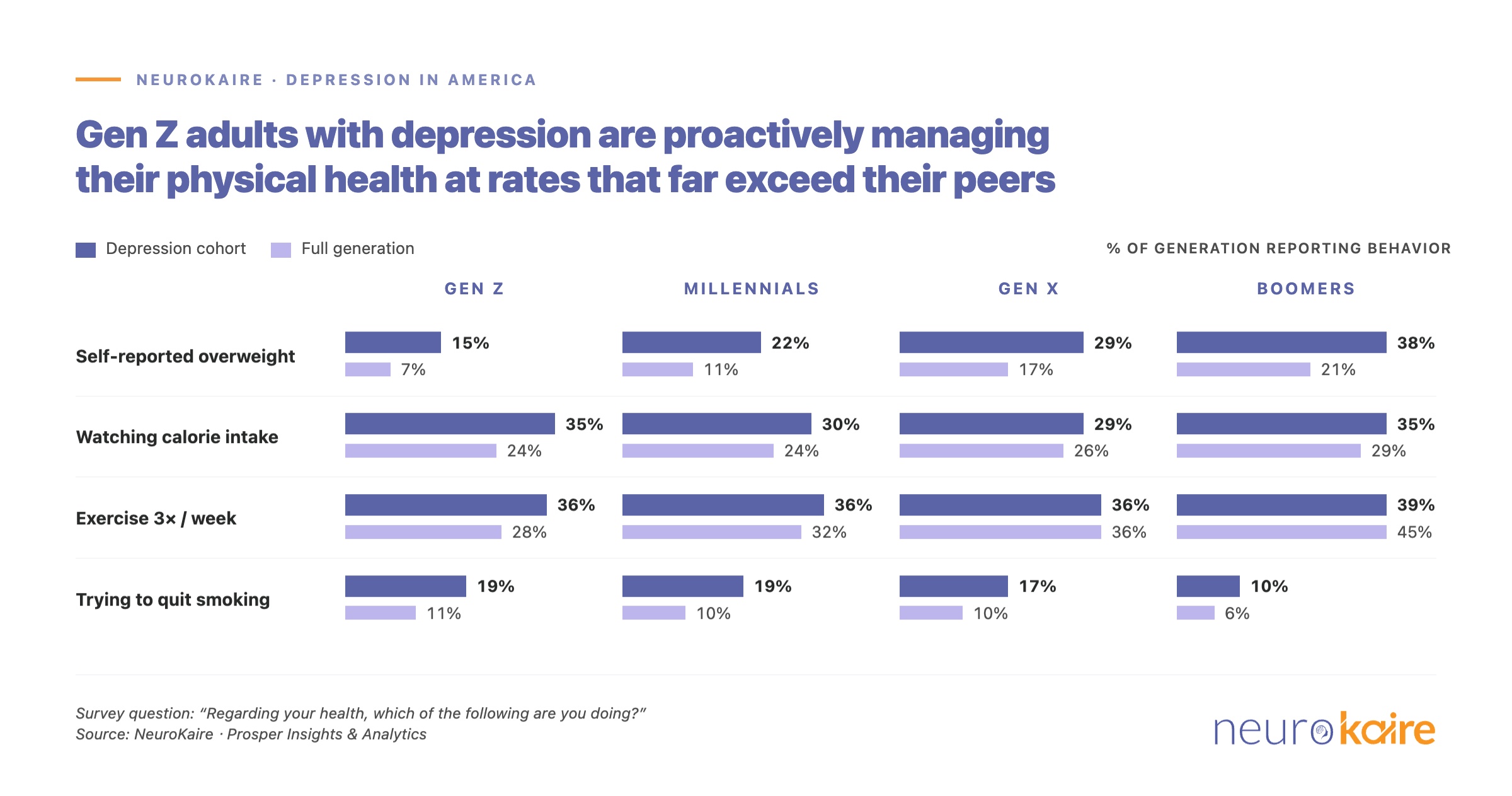
The NeuroKaire data challenges the assumption that patients who self-medicate are disengaged from their health. The opposite appears to be true. Depressed Gen Zers are 47% more likely to watch their calorie intake and 29% more likely to exercise regularly. Across generations, depressed Americans show elevated rates of health-conscious behaviors even as they pursue non-clinical treatment paths. These are patients who are actively managing their conditions. They are simply doing it outside the system.
Laifenfeld said this represents both a warning and an opportunity for the healthcare industry. “The self-medication data does not tell a story about patients giving up. It tells a story about patients giving up on a model that asks them to fail repeatedly before it works,” she said. “The science now exists to match a patient’s neurobiology with the medication most likely to work for their brain from the start. That is what precision psychiatry does. And the longer it takes to become standard practice, the more patients will continue building treatment plans on their own.”
NeuroKaire’s approach uses biological data to predict treatment response before prescribing begins, aiming to replace the trial-and-error model with one that is personalized from the first appointment. If the company’s data is any indication, the patient population that would benefit from this shift is far larger, and far more generationally diverse, than most industry observers have assumed.
The Self-Medication Generation is the first of three reports in NeuroKaire’s Depression in America research series. The next two installments are expected later this year.