
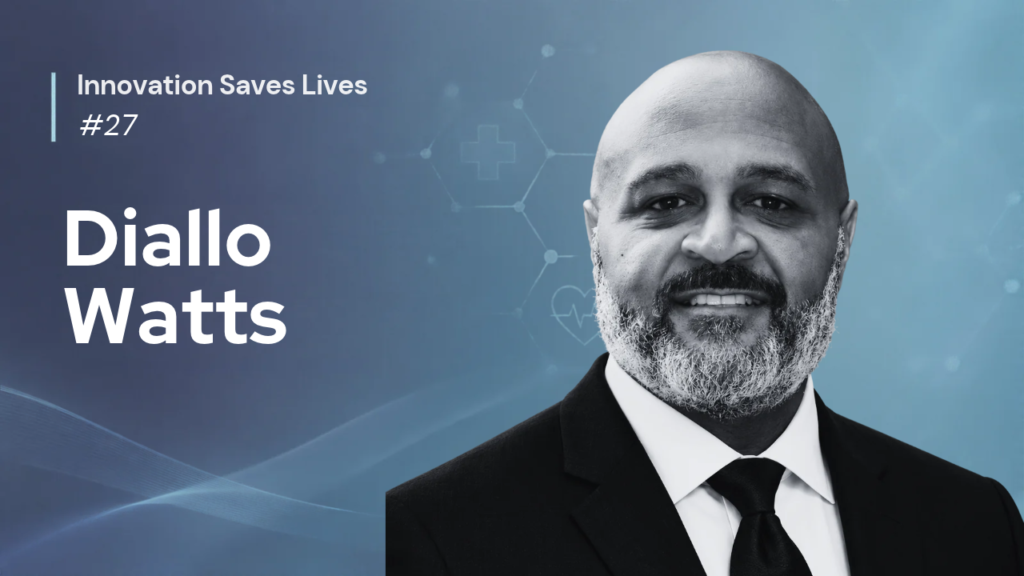
Sometimes innovation begins with a personal search for answers. For Diallo Watts, founder and CEO of RX Air 360 Inc., that search began in 2014, when his father was diagnosed with Alzheimer’s disease. An electrical engineer by background, Watts suddenly found himself navigating an unfamiliar healthcare landscape, looking for answers and exploring options that might help his father.
That experience ultimately led him into medical technology, specifically hyperbaric oxygen therapy, and toward a larger mission: making specialized medical treatment more accessible to the patients who may need it.
Watts joined Leonard Kim on the Innovation Saves Lives podcast to discuss his journey, the development of RX Air 360, and why improving access to medical innovation can be just as important as developing the technology itself.
Turning a personal experience into a healthcare mission
Hyperbaric oxygen therapy involves breathing oxygen in a specialized chamber under increased atmospheric pressure. While it has established medical applications, including certain non-healing wounds and other conditions, research into potential neurological applications remains ongoing and investigational.
As Watts learned more about the technology, he became increasingly interested in the gap between available treatments and patients’ ability to access them.
He recalls contacting multiple hospitals in his area while searching for options for his father. Although some facilities had hyperbaric chambers, access to treatment was not readily available.
That experience helped shape the idea behind RX Air 360. After connecting with physicians and others in the hyperbaric medicine community, Watts began working toward a solution that could bring medical hyperbaric technology into existing physician practices rather than requiring patients to travel to specialized facilities.
The company has developed a prototype and is working toward FDA 510(k) clearance.
Understanding the difference between medical and wellness chambers
An important part of Watts’ mission involves educating both patients and physicians about hyperbaric oxygen therapy.
During the conversation, he distinguishes medical hyperbaric chambers from the lower-pressure wellness chambers commonly found in spas and recovery facilities.
He explains that medical applications involve specific oxygen concentrations and pressure levels supported by clinical research and regulatory requirements. Wellness chambers operate differently, and their use should not be confused with established medical treatments.
Watts discusses several established medical applications, including certain non-healing wounds, carbon monoxide poisoning, burns, and crush injuries. He also addresses emerging research into neurological conditions, including Alzheimer’s, concussions, PTSD, and other forms of cognitive impairment.
Importantly, he recognizes that these neurological applications remain investigational. The distinction between established treatment and developing research is central to understanding the technology and communicating its potential responsibly.
Bringing specialized care closer to patients
For RX Air 360, accessibility is not simply about making another medical device. It is about changing where patients can receive care.
Watts points to the evolution of dialysis centers, urgent care facilities, imaging centers, and ambulatory surgical centers as examples of healthcare services becoming more accessible outside traditional hospital settings.
His vision is to follow a similar path with hyperbaric medicine by partnering with existing specialty physician practices and placing chambers where patients are already receiving care.
This approach could help reduce some of the logistical barriers associated with accessing specialized treatment while creating an additional service opportunity for participating practices.
The story behind Locked Out of Healing
Watts has also documented his personal and professional journey in his recently released book, Locked Out of Healing.
The book begins with his father’s diagnosis and follows the challenges of navigating the healthcare system, discovering hyperbaric oxygen therapy, and building a company around improving access to treatment.
It also gives readers a closer look at the setbacks, developments, and milestones involved in bringing a medical device toward regulatory clearance.
Ultimately, Watts’ message extends beyond hyperbaric medicine. He believes patients should become advocates for their own health, continue asking questions, and seek answers when traditional pathways leave them with limited options.
As he puts it during the conversation, “Access is the innovation.”
It is a fitting philosophy for a company working to bring specialized medical technology closer to the people it is intended to serve.
Want more Innovation Saves Lives? Check out the articles or head over to Apple Podcasts.