

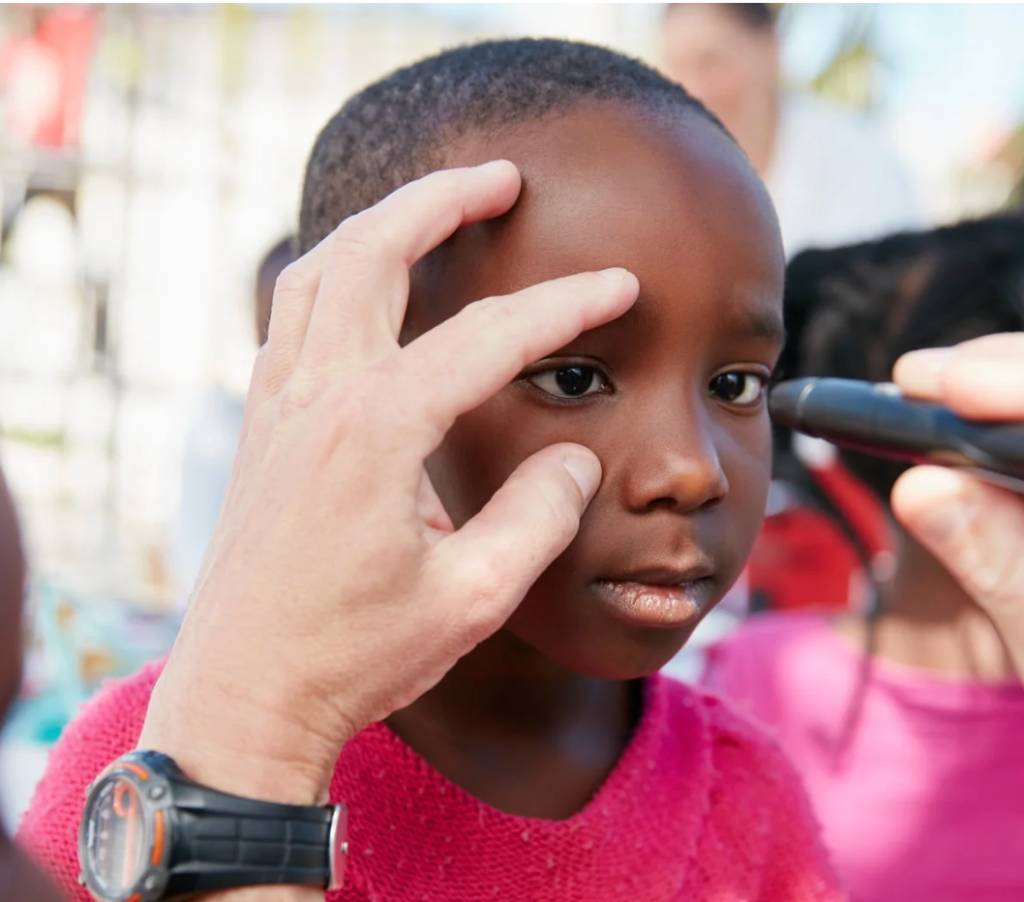
In much of the world, blindness is not a mystery; it is a map. It traces the highways of poverty, the back roads of neglect, the places governments forgot and markets never bothered to see. Globally, more than a billion people live with vision loss because basic eyecare never reached them, even though most of that loss is preventable or treatable. That is not an accident of biology. It is a decision—repeated, systemic—about whose sight matters.
CtheGood by KeraLink offers a different answer. It sells glasses and keeps none of the profit. Every dollar left after costs is sent back into the work of restoring sight in communities where blindness has become a sentence handed down for being poor, rural, or simply born in the wrong country. Here, commerce is not a shield for charity, but its engine.
A Leader Who Has Given His Own Body
Mark Clark, the director of eyewear at KeraLink International and the driving force behind CtheGood by KeraLink, is a father of six, a living liver donor to a lifelong friend, and a veteran of more than two decades in nonprofit work and 23 years in eyecare. His life has already answered the question of how much of himself he is willing to give. So when he steps into the role of building an eyewear brand that donates 100 percent of its profit, it does not read as a gimmick. It reads as continuity.
On paper, Clark runs an online eyewear line—CtheGood by KeraLink, operating through keralink.com and a CtheGood‑branded storefront—that offers computer lenses, golf glasses, and everyday frames. In practice, he is attempting to rewire the circuitry of reward. Instead of profit flowing up to executives and shareholders, it flows outward to fund programs that have already trained more than 140 specialists with the capacity to screen and treat up to 500,000 people in low‑income communities each year.
“We sell eyeglasses and 100% of the profit goes to help those who need eyecare in the US and low income communities around the world,” he writes in materials describing the effort. “Instead of giving our profit to name brands, expensive fashion models, or wealthy .com CEOs, ours goes to help those struggling with blindness.”
When a Pair of Glasses Becomes Policy
The numbers make the stakes plain. Vision loss is associated with hundreds of billions of dollars in lost productivity every year. Most of that loss falls on low‑ and middle‑income countries, and most of it is avoidable. Global coalitions now warn that, without change, the number of people living with the consequences of sight loss will climb toward 1.8 billion within a generation. These are not abstract figures. They are children failing classes because they cannot see the board, adults pushed out of work, elders losing both sight and independence.
KeraLink International, the nonprofit behind CtheGood by KeraLink, has responded with a strategy that reaches far beyond retail. It backs AI‑enhanced diagnostic tools and non‑pharmaceutical treatments for early detection of eye disease. It supports corneal‑regeneration research designed to free poorer nations from dependence on donated tissue. Its leaders speak openly of a future in which communities that were once recipients of charity become hubs of eye‑health innovation in their own right.
CtheGood by KeraLink is the small, visible tip of that effort. The frames on a U.S. customer’s face are connected, by design, to a clinic in an eyecare desert in the American South, or a screening program in a rural district abroad, where a trained specialist now has the tools to catch disease before it steals someone’s sight.
Choosing to See Each Other
Skeptics will say the market does not reward this kind of idealism, that a company giving away all its profit is, at best, a niche experiment and, at worst, a slow‑motion collapse. Perhaps. CtheGood by KeraLink’s own disclosures acknowledge that it is early, that customer numbers are not yet notable, that it is still its first year of revenue. There is no guarantee that moral clarity will translate into market share.
But the deeper truth CtheGood by KeraLink insists on is that sight has never been evenly distributed and that this inequality is not inevitable. Every frame sold is a small refusal to accept a world where clear vision is a privilege. In Mark Clark’s hands, a simple pair of glasses becomes a quiet demand that people see one another—not as consumers to be extracted from, but as neighbors whose ability to read, to work, to recognize the faces they love, is worth restructuring the flow of profit itself.
In a time when brands wrap themselves in causes for clicks and goodwill, CtheGood by KeraLink does something harder. It does the math differently. It asks what would happen if the entire margin of a business were treated as a public resource, if a company’s success were measured not in valuation, but in the number of people who can suddenly see their own lives clearly again. That is more than a brand. It is, quietly, a movement.